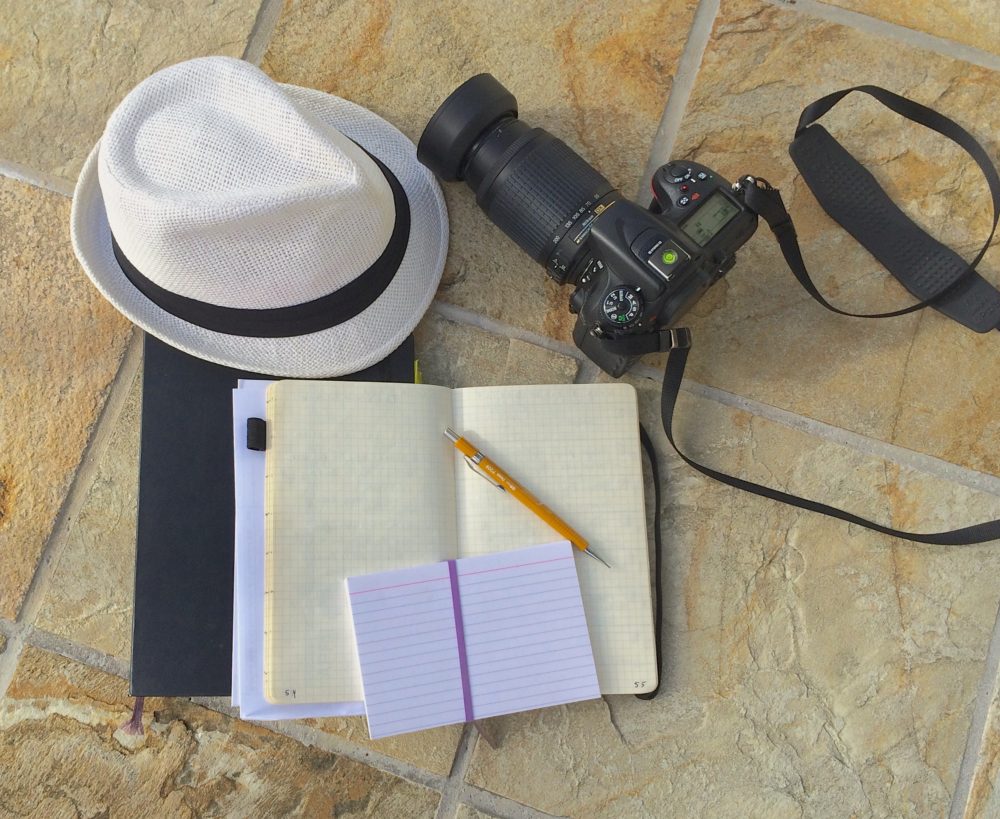
ADHD and Exercise: Ten Steps to Finding What Works for You

Exercise. A word that can stir up the worst case of “shoulds”.  Because we know we should, because we want to be healthy, because we want to loose weight, because we feel like it is something we should do for what ever reason, and that is the problem. We listen to other people’s reasons and we don’t know what our reasons are. I place exercise in the same category as saving money and eating a reasonable diet. A causal browse of a book store or the Internet will net you tons of advice about what to eat, how to save money and exercise, so much so that in all the noise we forget to listen to the one voice that matters: our own.

Finding a form of exercise that we enjoy, that remains challenging, and that we can do consistently is of vital importance for individuals that have ADHD. We have to move. We are the pacers, the doodlers, the kids that spin, climb, and try just about anything that is physically challenging and jacks up our adrenalin and endorphins. Run a marathon? Fifty mile bike ride? Climb a mountain? We are into it. We are also the people that will just stop an exercise program when we get bored and because most people with ADD/ADHD have the attention span of a goldfish on cocaine, this it happens frequently.

People with ADHD also struggle with their minds wandering, coping with thousands of thoughts rushing through our minds every day. Exercise is a way to wear your body out in order to quiet your mind.  I wrote a post about focus and risk here , about how martial arts training helped with my focus.  The part I left out is how much easier it is to calm your mind when your body is tired.
Meditation is terrific for most people, but for people with ADD/ADHD it feels impossible. Finding a form of exercise that exhausts your body will make it easier to quiet your mind.

Here are ten steps to finding a form of exercise that works for you.Take your time and go through the list. It may seem like a lot of steps, but answering the questions will help you choose wisely, and find a form of exercise that works for you and fits into your life.

1. Make a list of physical actions you like to do, such as dancing, swimming, walking, running, team sports, biking, lifting weights, jogging, hiking, or climbing. Choose two that you like to do the most and mark them in someway.

2. Where do you like to spend your time? Outside or indoors? If you live some place where your ability to be outside will be limited by the weather, keep this in mind.

3. Do you like to exercise alone or with others?

4. Are you competitive? Do you like to play against other people?

5. Do you have any injuries or physical limitations? Many exercise programs can be adapted to accommodate physical limitations, so do not let this limit your thinking, just write it down.

6.  Look at your list from question one. Investigate the options for pursing what you like to do. Make a list of all the options available. List the costs (outfits, equipment, shoes, etc.) for your top two choices from question one.

7. How much do you want/have to invest in your exercise program? Having a budget will help avoid impulse spending and signing up for gym memberships that go unused. Only join a gym if you already know exactly what you are going to do at the gym and when you are going to do it.

8. Really look at your schedule. Make a list of times that you could exercise, taking into consideration your energy flow and reality. If you are not a morning person, do not think that getting up at five in the morning to exercise will really happen, be realistic and do not set yourself up to fail. If you don’t have a planner, or are struggling with time management check out my post here.

9. If it has been over a year since you have been to see your health care provider, go and get a check up. This is really important for people over fifty. Please read the Mayo Clinic’s advice for when you need to have a check-up before you start an exercise program here .

10. Do it. Just start. It can be really hard to find a way to start but the rewards are worth it. Do not compare  yourself with anyone else, do the best you can and be kind to yourself.

Use these questions to find what works for you, if your first attempts do not work, check out your options and expect that at times of major life changes (babies, small children, caring for older parents), or if you have an illness or injury you will get off track or may have to find another way to exercise.  When that happens go through the list again, take as much time as you need, to find what works for you.


An Eclectic Summer Reading List


I love to sit on my porch and read in the summer. As a kid I could not wait for school to be out for the summer, so I could read what I wanted to read instead of what was required. I would spend every rainy day curled up with a book. I spent most summer nights reading until I fell asleep with the book in my hands.
I still fall asleep with my book in my hands sometimes, and I don’t get to curl up and read as much as I would like to anymore, but summer is still made for reading. I put together a list of some of my favorite books. Some have been featured in my Year of Women’s Voices Series, some were published a while ago, and some are new. It is a pretty eclectic list, and if you are looking for something to read I hope you find something here.

Intense and Sexy Reads

By Fiona Zedde
Bliss
Broken in Soft Places
Dangerous Pleasures
Every Dark Desire
Desire at Dawn
For more about Fiona here is the link to my review of  Fiona’s books .

By Megan Hart
Tear You Apart
Vanilla
Switch
Everything Changes
Ride with the Devil
Out of the Dark
Lovely Wild
Precious Fragile Things
All Fall Down
For more about Megan here is the link to my interview with Megan .

By Tiffany Reisz
The Siren, and the rest of the series. Beware, this book is the beginning of an eight book series, don’t say I did not warn you.

The Headmaster
Seven Day Loan
The Mistress Files
Submit to Desire
The Last Good Knight (Serial Novel)


Memoir: if you only read one memoir this summer, make it one of these two:

Just Kids by Patti Smith. Here is the link to my review .
Let’s Pretend this Never Happened by Jenny Lawson. Here is the link to my review .

Science Fiction/ Fantasy/Urban Fantasy


Everything ever written by Octavia Butler, no seriously, and here is a link to my list to get you started .

By Helen Oyeyemi
Boy Snow Bird
White is For Witching
The Icarus Girl

By N. K. Jemisin
The Hundred Thousand Kingdoms Here is the link to my review .
The Broken Kingdoms
The Awakened Kingdom  

By Jacqueline Carey
This is another long series (collectively Kushiel’s Legacy) but it is so worth your time. “Love as thou wilt”.
Kushiel’s Dart
Kushiel’s Chosen
Kushiel’s Avatar

Kushiel’s Scion
Kushiel’s Justice
Kushiel’s Mercy

Naamah’s Kiss
Naamah’s Curse
Naamah’s Blessing


By Katherine Dunn
Geek Love  Not for the squeamish, here is the link to my review.

Here is to lazy summer days, reading and summer fun, and an adult beverage or two.


For Your Consideration:Ten Tips for Submitting Creative Work

IMG_1520_2

While most often associated with gambling, the phrase ” if you don’t play you can’t win” is what I say to myself every time I send off a submission for review, not because it is a gamble but because of the truth of the statement. If you are one of the many who dream of having your work traditionally published, displayed in a gallery, or publicly recognized, you have to submit it for consideration by other people.
Is is easy? Yes, it is easy to hit send, but it can be incredibly stressful to assemble a submission package, book proposal, portfolio, manuscript, short story, or any other creative project. Some people get so overwhelmed they never submit anything. It is an act of confidence for any creative person to submit their work for review. As Erykah Badu says ” I’m an artist and I’m sensitive about my sh*t…” and Ms. Badu is so right. I have yet to meet a creative person who is not personally invested in their work.

Just reading submission guidelines can be overwhelming and knowing that making a mistake can get your submission rejected before it is ever reviewed can create so much stress that many individuals give up. A large percentage of creative people have attention issues and struggle with details. Here are ten organizational tips to make the submission process less stressful.

1. Read the submission guidelines. Read them again. Print them out, underline, and highlight the requirements for the submission.
2. Enter all deadlines on your calendar. What no calendar? Read my post on keeping track of multiple deadlines and projects here.
3. Start a computer folder, a flat file or file box and keep everything related to the project in one location.This keeps key information and work together.

4. Date all drafts, or versions of your project. This prevents you from sending the wrong version of the file when it is time to send in the final version.5. Set reminders for key dates, these can be written reminders or electronic reminders.

6. Have another person, preferably someone who is detail oriented review your submission before you send it. Give them the guidelines and ask them to review your submission to see if you have everything required. Buy this person a beverage of their choice for helping you.

7. Be realistic and take your time. This is very difficult for many creative people, and particularly difficult for people with ADD/ADHD. Creating is fun, paying attention to details not so much, but if your brilliant work is never reviewed because you did not follow the submission guidelines you are defeating yourself.

8. Remember that as hard as it is to hit “send” or mail that package, it is the only way it is going to get reviewed: If you don’t play you can’t win.

9. Expect to have some anxiety after you submit your work. See Ms. Badu’s quote above, then get to work on your next project.

10. Celebrate. You have done something that many people dream of and never ever do. Celebrate your determination, celebrate your work, celebrate no matter what.

So hit the send button, drop off the portfolio, submit your creative work, jump in with both feet.

Money for the Distracted Book Review: Saving Money with The life-changing magic of tidying up: the Japanese Art of decluttering and organizing

Clutter, stuff, things, what ever you like to call all of the items that magically multiply to fill every inch of your house, attic, garage, basement, shed, and storage units. Clutter eats your money like a hungry dog on a meat wagon. For people with ADD/ADHD clutter is a problem for several reasons. We struggle with decision making, we can always think of ways that said item could be useful, we have so many interests, hobbies, and things we are fascinated by, that we collect things at an alarming rate.
When we become distracted by the next thing, the items are still there from the first thing, or we buy everything we need for a project and then become distracted by another project and never get back to the first project.
Our powers of hyper-focus allow us to work in chaos that would shut most people down, but can lead to the kind of room that is ridiculously over stuffed. It can also be a constant source of friction for others that share our space.
Clutter costs money beyond the initial purchase as we spend money on storage containers for what we bought, re-purchase items that we can not find when we need them, and spend money for storage space for the excess in our lives. Kitchen clutter costs money when you throw out expired canned and packaged goods, and fresh food forgotten in the refrigerator. Clutter is a huge drain on your finances and causes stress. Many people, those with and without attention and impulse issues struggle with clutter. De-cluttering is like dieting, we all know what we are supposed to do, but damn, it is hard to stick with it, and quick fixes do not work. So, what is the solution?

Enter Mari Kondo, her amazing book The life-changing magic of tidying up: the Japanese Art of decluttering and organizing, and the “Konmari” method of tidying. Her philosophy and word choice will feel odd to some, as this work is translated from Japanese, but her ideas about getting rid of everything that does not “spark joy” when you pick it up is bang on. She does not believe that following another person’s idea of what you should, or should not discard will ever stick, nor does she believe that rules such as “one in, one out, or one in two out” will work and that in the end you will go back to your cluttered ways.

As someone who has struggled with clutter and collections forever, this book was clear, easy to follow, and gave the best advice: No one but you can decide what is enough of any type of thing, but if it does not “spark joy” it does not belong in you space. As she rightly says, “only you can decide what is enough” and if you want to keep one hundred pairs of shoes it is okay as long as you genuinely love each pair. Unlike some methods of decluttering that have left me feeling like I was forced to discard things dear to me, this method made me feel like I was in control, and that in the end it was my choice and I was very happy and felt like a weight had been lifted when I donated clothes that no longer “sparked joy” to Goodwill. We can also put some of our bigger things into Self Storage Units to help us in case we can’t get rid of them at that moment, not only does it mean that we clear our home of what we don’t need, but we are able to make sure our things are correctly stored before being given away/sold.

Ms. Kondo has a set routine for discarding items, moving you from less difficult choices to more difficult ones, starting with clothes, moving to books, and finally everything else in the order she has listed in her book. Unlike other books that recommend that you have someone else touch and hold the item you are considering, she has the person touch and hold their item while asking themselves “Does this spark joy?”.
Her method may seem quirky, but by doing this, I was able to discard half of my wardrobe. Others I have talked to that are following the “Konmari” method have discarded even more. This may sound wasteful but most people only wear about twenty percent of the the clothes they own so this a way to have every outfit you pick up be one that you want to wear, not one that gets pulled out, looked at, and stuffed back in the drawer or closet.

She also has you discard by item, a grand way to see everything of that type you own. This was a little overwhelming but she argues that we have things stored all over and that we really do not know what we own until we get it all in one place. This will be challenging, as you will need a space to work in that allows you to do this, but in the end it made the process much easier. We have discussed getting a Workshop storage shed for the backyard that we can put all these small things in as we sort them out mindfully, this can help us greatly as it means we can keep these things quickly to hand as we get through them piece by piece, whilst compromising on all the clutter without it being actually within the house.

Ms. Kondo states that it takes about six months to complete the process of discarding but to the date of publication of her book, she has had no one that needed to repeat the course or who has slipped back into their old ways.

So are you ready to give it a go and start saving money? I started the process over the Memorial Day holiday, and will keep you posted as I progress.

Thoughtful Throwback Thursday

Wondering where the time went, and looking forward to adventures to come.
Five years in the blink of an eye.
Our first Fair.
If I just concentrate I can get this thing to move.
Where is my coffee?


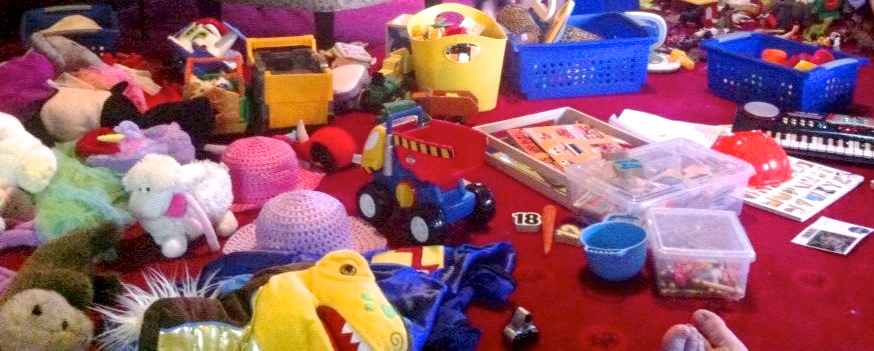
Toddlers!


Preschool!


Oldtimers!

ADHD and Money:The Slow-Cooker Method of Savings

Many ADD/ADHD people are visual people. We struggle with organization because if we loose sight of an object it might as well not exist. So what does that have to do with automatic savings? If you have the money deducted from your paycheck before you see it, you don’t miss it. I am not talking hundreds of dollars to start your savings project. If you are struggling to pay your bills, I am sure right now that you think I have lost my mind, and that you could not possible squeeze another dime out of your paycheck, or you have tried to save a fixed amount each month in the past but have ended up using it to pay bills because you started with too high an amount.

I am talking a small amount. How small? How about ten dollars a paycheck? Twenty dollars if you are paid once a month. Set it up to come out before you get your check. Most people are forced into automatic deposit, and it it very easy to set up a spilt deposit through your employer.
Ten dollars. That is all, less than the price of two fancy coffee drinks, less than two fast food meals, less than two lunches purchased at work. If you have an bank already, but do not have a savings account, open one, make sure it does not have any fees that will eat away at your savings. You can even open an on-line savings account and set it up an automatic transfer to come out of your paycheck.

Now the next step is really important. Do not look at your balance for the next year. That’s right a whole year. If you are nervous about this, have a trusted friend look at your statements for you, or if your partner is more trustworthy about money have them keep track of the balance. After one year, when you look at your balance you will be surprised at how quickly the money added up.

If you are like many ADHD people the impulse to spend it will be great. Do not do it! This is the start of your emergency fund. You know the extra money you are supposed to have sitting in the bank for emergencies? This is the seed. I know that some of you will have read about emergency fund recommendations that are so common in financial self-help books or on the blogs of sites like GoFundMe, stating that you should have three to six months of cash saved in a bank account for emergency needs, before you stop reading and give up because you can not even imagine how that would happen when you just pay the bills now.

In one year you will have $10.00 X 26 = $260.00 that is if you get paid every two weeks and save $10.00 per pay period, or $20.00 X 12 = $240.00 if you get paid once per month. It may seem like a small amount , but it is so much better than nothing. The balance will have also increased because of interest. Interest rates are pretty low right now for savings so I did not include them in the illustration, because the point of it is to prove to yourself that you can save money. It is what I call the slow- cooker method of savings.You just set it up and forget it, and just like a warm home-cooked meal that magically happens when you use a slow-cooker, the money accumulates. If you are feeling bold after the first year, increase the amount you save per month by five or ten dollars.

Many people are so deep in debt that they believe that there must be some great grand secret that everyone else but them heard at birth, and that they are never going to be able to handle their money, get out of debt, save money, or retire. This strategy also works for retirement accounts, set up as a pre-tax percentage. I am sure that there are retirement advisers, and people way better at managing money than I am, screaming right now at this approach. My guess is that they have never had the issues with impulse control, forgetfulness, or holding a steady job that many people with ADD/ADHD have to contend with on a daily basis.

Money issues come with an inner conversation of shame, guilt, embarrassment, and unworthiness about money. Setting up automatic savings can help break the pattern. Try this method, it does work. If you save anything, it is better than saving nothing. Never underestimate the ability of small steps toward a goal, or to prove to yourself that you can accomplish an project. Everyone has to start somewhere, and where you are is the best place to start.

Slow But Steady: Any Progress is Progress

I love this turtle because he helps me to remember that no matter how slow you are moving, if you keep moving you will get there. Through kids being sick, through family illness, through birth, death, and all of life’s messy bits, and most of all through your own inability to focus, if you keep moving you will reach your destination. Remember this when you are frustrated with your creative output: keep going.

I had a short fiction piece accepted this week for publication in an upcoming anthology. My kids think it is pretty awesome that I’m going to have a story in “a chapter book”, and so do I.   I’m not going to go into how long it has been since I had a piece published, or how many rejections proceeded this acceptance, or how many times I have submitted manuscripts, because none of it matters. The point of this post is this: all those days that I squeezed in fifteen minutes of writing made a difference. Not giving up is what matters. If you quit writing, it is impossible to get anything published.

I will confess to struggling mightily in the warm months to stick to my writing schedule. The lure of outside kicks my ADHD into high gear. After a winter of being inside all I want to do is play. My kids are home in the summer time, and that cuts into my writing time as well. I have some ways of dealing with kids at home and last year I posted some tips for sticking to your writing schedule when your kids are out of school, and you can read them here .

Even if you take some writing breaks over the summer, make it productive, read that To Be Read Pile, collect photographs, experiences, and memories to feed your writing later.

Most of all don’t give up, if you keep writing you will finish. Just keep moving. If you can only write one sentence, write a sentence. Like snowflakes it will add up. It may take years for you to accomplish what others accomplish in a month, it is okay, just keep writing.

Stick with it. Keep going, don’t quit, enjoy the journey as much as the destination.

Starting from Scratch

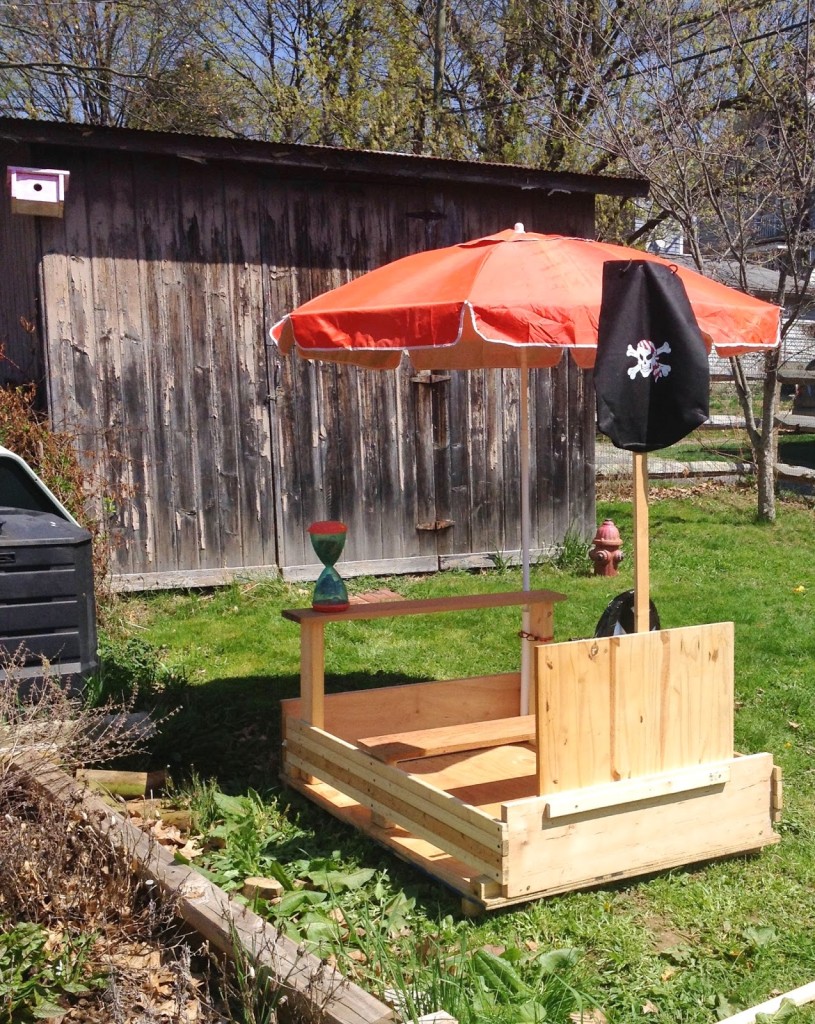
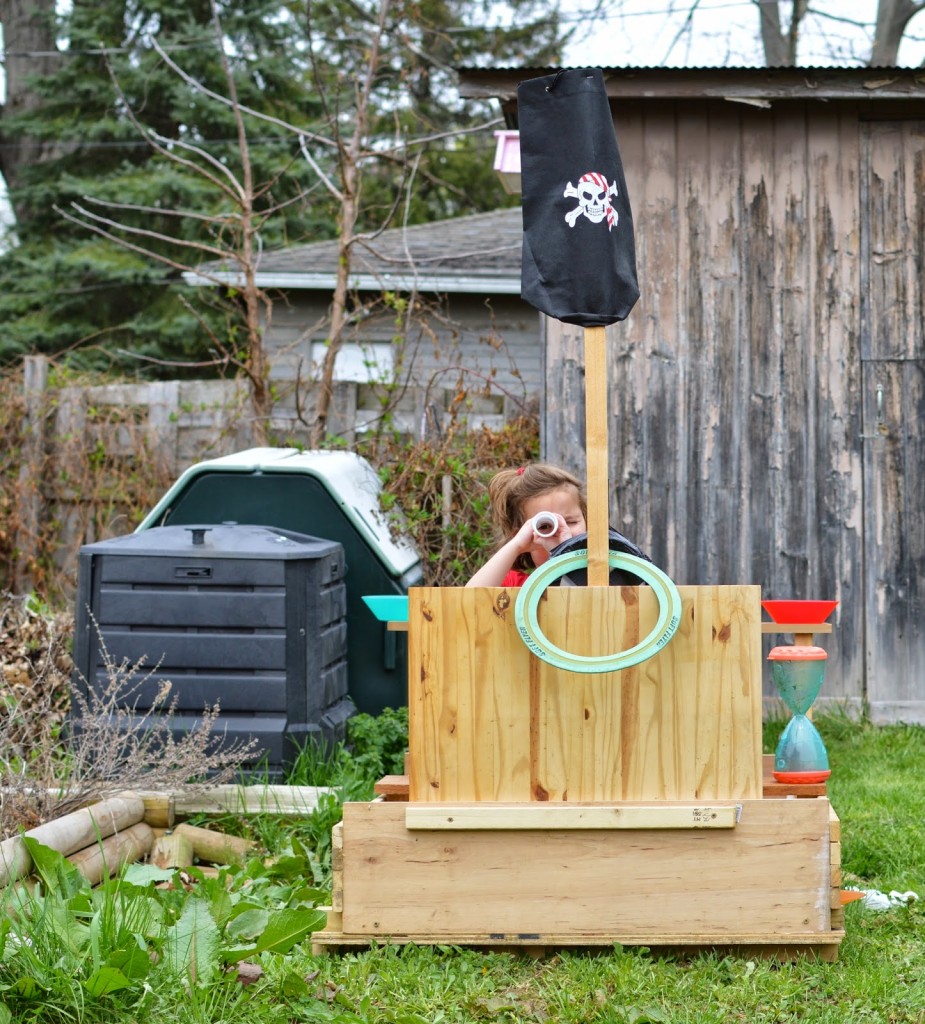
My kids think I can build or fix anything and this past weekend they asked for a pirate ship.  So after carefully surveying the collection of scrap wood and various other bits and pieces of raw materials in the basement, garage and recycle bin. This is what we ended up with:

It won’t win any prizes but they had a lot of fun helping me build it and making decisions about how they wanted the ship to look, and what amenities would be included. We had some things that didn’t work, we experimented, we were creative, and most of all we had fun.

I didn’t start out trying to teach them anything, but when they tell people the story of how they built their pirate ship, they are very proud of their contributions, and glory in the telling of how we problem solved.
Listening to them, I realized that beside being a really fun day, they had also learned a little bit about being resourceful, using what you have, and starting where you are.

I feel the same why every time I start a writing project. I inventory my lists of story ideas, found objects, interesting news bits,  and old story files to create something. Any creative project starts with an idea, a whim, a scrap of thought, a problem to be solved, or a request.

Many people say to me that they want to write but don’t know what to write about. This is my answer: Use what you have, start where you are, and don’t expect your first draft to be perfect. Just like our pirate ship, it needs the rough edges smoothed, and a coat of paint. That is what editing is all about, but you can’t edit a blank sheet of paper.

Even if you don’t have little pirates in your life asking for ships, take time to build /create/ write /draw/ photograph something. Quit staring at life waiting for something to happen, and make something happen.

Happy Sailing!