Money for the Distracted: 10 Ways to Curb Impulse Spending


This is my second post in the money series. In my first post about money and ADD/ADHD, which you can read here if you missed it, I talked about how managing finances is difficult for people with ADD/ADHD.  A disclaimer, I am not an accountant, financial advisor, or economist, these are just some basic suggestions to organize your money life so you can feel more stable in how you handle money.

Many people struggle with impulse spending. It is even more difficult for people with ADD/ADHD, because we can jump into extravagant spending sprees, all in the name of a project related to house, food, kids, hobby, new job, etc. and be in debt up to our eyeballs before we know what the hell just happened.
I am not talking about a candy bar at the check out.  I’m talking about an entire library of books, a workshop full of tools, a new work-out wardrobe, a new house, kind of impulse spending. I talked about how hard yard-sales are for the distracted here.

So here are ten things you can do to stop impulsive spending:
1. Have a plan before you go shopping. Make a list. This is the hardest part: IF IT IS NOT ON THE LIST DO NOT BUY IT.  Really, do not buy it. Even if it is a great deal. Walk away. It is not a great deal if it was not on the list. This the only way to stick to your plan.

2. Take one-click shopping off of your phone. While you are at it, take the shopping apps off your phone. Randomly scrolling through shopping apps because your are bored, tired or can’t sleep is bad. It is the new version of infomercials that convince you that you NEED to spend $500.00 to loose weight/be a millionaire/ grow hair/ juice/ have a beach body, etc.  If you have to actually log in to a desk top computer or tablet to shop it will slow you down.

3. Delete your credit card information from the sites that are weaknesses, whatever that is, shoes, clothes, books, or the everything store. Again this will make require that you locate your credit card and then enter the information to make your purchase. This will buy some time for you to THINK about the purchase.

4. Before you spend anything that is not food or essential, ask yourself: Is this moving me closer to my goals? If the answer is no, the complete collection of the Crocodile Hunter on DVD is not going to get you closer, do not buy it. If your goal is to save money for a trip/vacation/emergency fund/house, etc, impulsively spending money will not get you there.

5. Find free alternatives to feed the need to acquire objects. Get a library card. Use it. Filling up a bag with books, Cd’s, and DVDs can feel like shopping.  The best part? You can take them back and do it all over again, for free!

6. Although some folks advocate cutting up all your credit cards, and going to a cash only system, I live in the real world, and I like to travel. Having a credit card makes it so much easier to travel. To curb impulse spending with your credit card, leave it home, (in a safe place where you can find it) when you are in your hometown. If you want whatever it is that you were going to buy bad enough to go all the way back home, find your credit card and then drive back to the store to buy the item, then you have given yourself some time to really think about the purchase.

7. Set a monetary limit for purchases that have to be discussed with another person. This person will need to be someone who will not get on the impulse train with you. It may seem silly for a grown person to have to talk to someone about their purchases but having to explain why you NEED the complete DVD collection of  the Golden Girls will make you think about twice about buying it.

8. Avoid the trigger stores. You know what they are. Bookstores, hardware stores, shoe stores, clothes stores, anywhere you could spend all day and your next paycheck. Do not go. If you do visit one of theses money-suck stores leave everything but cash you can spend behind. No debit card. No credit cards.

9. Write the word Think! on a sticky note. Place it on your credit card. Alternatively you could put a picture that represents you money goal on the front of your credit card, use whatever will remind you to stop and think before you spend.

10. Have someone else shop. This will not work for everything and every purchase but if your weakness is the grocery store, make a list and send someone else. Use an on-line service if you do not have a partner or friend who would do this for you.  if you are someone who routinely overspends at the grocery store, the money you would spend on the service will be off-set by the money you spend on impulse purchases.

I hope these help. The key in all of this is to find a way to give yourself time to think and decisions that support your money goals.  I have used each of these tips at one time or another. They do work. Remember to be kind to yourself. If you get discouraged go back and read the first post in this series.
 

A Year of Women’s Voice’s Retrospective


I started my Year of Women’s Voices project about this time last year. As an obsessive reader, book reviews are one of my favorite posts to write.  Each review features my thoughts on the craft of writing and observations about story telling learned from each writer. I have arranged my 2014 posts in chronological order, most recent first.  If there are writers here that you have not read, challenge yourself to read one new author this year.


Zoe Kessler: ADHD According to Zoe


Patti Smith: Just Kids


Jenny Lawson: Let’s Pretend this Never Happened


Taking the Long Way Home

After six weeks, ten thousand six hundred and ten miles, four suitcases, two sets of grandparents, and a wonderful start to the year, I am finally home. Happy, exhausted, and full of new ideas for this year’s posts. I enjoyed writing my Year of Women’s Voices series and will continue the book review series this year.  The blog will continue to feature tips for living with ADHD, time management tips, inspiration and ideas for writers and creative people of all types.
Last week I started a new series about money management and ADHD, follow this link if you missed it . Today I am starting another new series: Silent Sunday. Once a month I will post photographs / photo essays. Use the photos for inspiration, a story prompt, or just enjoy them.


Money Changes Everything: ADHD and Money

Money. The topic everyone wants to talk about and no one wants to talk about. There are many, many books on the market telling you how to handle, invest, save, spend and bank your money. Most of them assume that the individual reading the book has an attention span longer than a goldfish. Indivduals who have ADHD struggle with money managment for a number of reasons. Under-employment, inability to maintain a job/career, creative careers that pay irregularly, academic struggles that lead to low paying work, impulsive spending, forgetting to pay bills, lack of organization, and procrastination. This year on the blog I will feature one post a month about money. Money is difficult to discuss because so so many people equate their self-worth with their bank account. If you don’t get anything else out of this series know this: You are Not Your Money.  In an environment where we are constantly bombarded by messages to the contrary, it is often hard to remember this. Money is a tool, it provides opportunities and access. Money can not buy you happiness, or love.Money management is possible and it means you being in control of your money. I have been so broke I couch surfed before it was a thing, lived out of my car for six months, and ate a hell of a lot of rice and ramen noodles. When I finally was making money, I impulsively misspent and then spent 10 years paying it off. Did being broke make me bitter? Nope. I know that it won’t kill me. I know how to survive. I also know that it is so much better to be in control of money.If you are struggling with money management, I encourage you to take a deep breath, know that you can get it together about money, and that it is worth it. The first book that I recommend that you read is Your Money or Your Life: 9 Steps to Transforming Your Relationship with Money and Achieveing Financial Independance by Vicki Robin and Joe Dominquez. Get it from the libray, borrow a copy, or buy it used, but read it. Some of it may seem dated but the exercises will help you get a handle on where you are right now in your relationship with money. My favorite exercise from this book is figuring out how much of your time you trade for things in your life. You will never look at material goods the same way after figuring out how much of your life you trade for things.I will leave you with my favorite  quote about money: “To walk in money through the night crowd, protected by money, lulled by money, dulled by money, the crowd itself a money, the breath money, no least single object anywhere that is not money, money, money everywhere and still not enough, and then no money or a little money or less money or more money, but money, always money, and if you have money or you don’t have money it is the money that counts and money makes money, but what makes money make money?”Henry Miller Tropic of Capricorn (1939) 

Travel Journals


Challenging is the best way to describe writing while traveling. Routines are disrupted, changing time zones can be wicked hard physically, and with ADHD the distraction of new places can make it very difficult to focus on writing. If you are traveling with your family, kids, or even with other adults it can be difficult for them understand why you need to have time alone to write. Negotiation is critical for having an enjoyable trip and getting the creative time you need. I am grateful that my family understands that I need to take time out to write, and I am careful to not let it keep me from enjoying the moment.

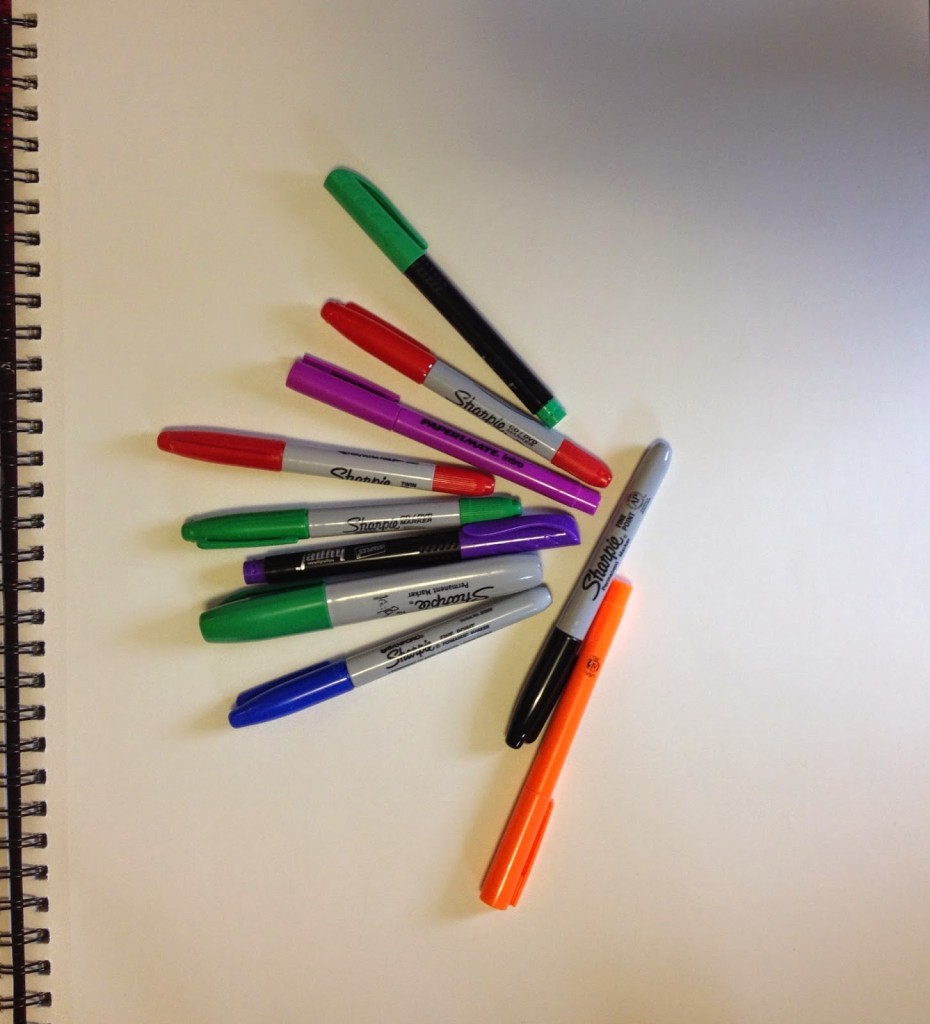
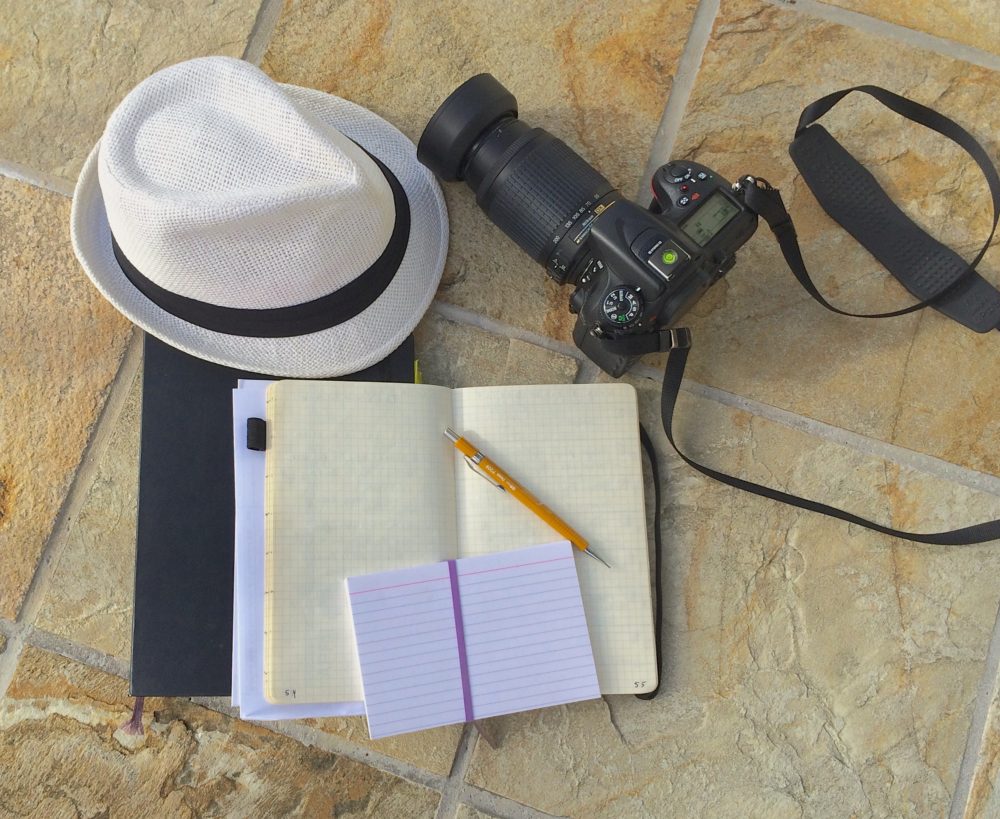
Taking time to get out of your head to see and experience the world around you provides raw material for writing. Travel brings with it the opportunity to see new things, taste new foods, experience new cultures, and to meet new people. Take advantage of these experiences and collect your impressions in a travel journal, notebook, or other writing tool of your choice. I prefer paper for travel as I never have to worry about not being able to record my thoughts because of a lack of electricity. Small notebooks are great for this, and I am very partial to 5×8 hardcover sketch books. These kinds of books become a permanent record of my travels, fit in my flat filing system that I talked about here, and are unobtrusive. Although I adore fountain pens, I only carry cheap ball points while traveling, they don’t  leak and are easy to replace if lost or broken.

Embrace the chaos that travel brings. Record your thoughts, feelings, and impressions. Capture bits of overheard dialogue and make character sketches. Use what you experience to enrich your writing.  In the past I have relied on a small point and shoot camera to record pictures as resources for my writing, this trip I am using Evernote to take pictures and write extensive captions so that I remember where and why I took the photo. No matter what you are writing having images to remember your experiences is invaluable. If you are Blogger this is a fantastic way to collect images for future posts as well as generating ideas for your blog. If you write fiction it is great to use images as part of your character and location sketches.

Enjoy your trip. Make memories. Record your life. Use it all.

Filling the Well

Taking time to think, plan, and rest is a key part of the creative process. I call it filling the well. It doesn’t have to involve travel but it makes it way more fun if you can leave your everyday responsibilities behind. I can’t say that traveling with four-year-old twins is easy but seeing the world through their eyes is a wonderful way to see old things in new ways.

I’m taking some time to fill the well. Take some time to fill your well. See you next week.

New Beginnings

Ha Long Bay 2009

Each  year I look back at the written list of goals taped to my desk. Some goals are always on the list. That doesn’t mean I didn’t accomplish them, some goals have no end point, such as being a supportive partner and a healthy person. Checking off a big goal always feels great. Looking back over the year and seeing check marks and lines drawn through a goal always makes me smile. I limit myself to ten big goals per year divided between Self, Family, Financial, Health and Community.

I don’t make resolutions, I make plans. Each goal gets broken down in to tiny little baby steps. I don’t get overwhelmed if I make tiny changes. I also know that small changes add up. Each day, I make sure that I have done at least one thing to move me towards my goals. It prevents me from becoming discouraged when life gets complicated. So many people say they want to write but don’t write down their writing goals, fail to make a plan, and then wonder why they don’t accomplish their goal.

If you want to accomplish a goal, make a plan. Break your plan down into small steps. Don’t discount the power of small steps. How small? When the kids were babies and I stayed home with them, if I managed to get 250 words written per day I was very happy. Even 250 words adds up, and keeps you moving forward. It can seem that life is conspiring with evil beings to thwart your best efforts to keep going. A parent becomes ill, a partner has surgery, your kids get sick, you get sick, the dog gets sick, and so it goes.

The key in all of this is to keep moving, as best you can. You might have to stop and take care of your family and yourself, but don’t stop forever. Pick up your notebook and get going again, don’t feel like you have to stop forever because you stopped for a while.

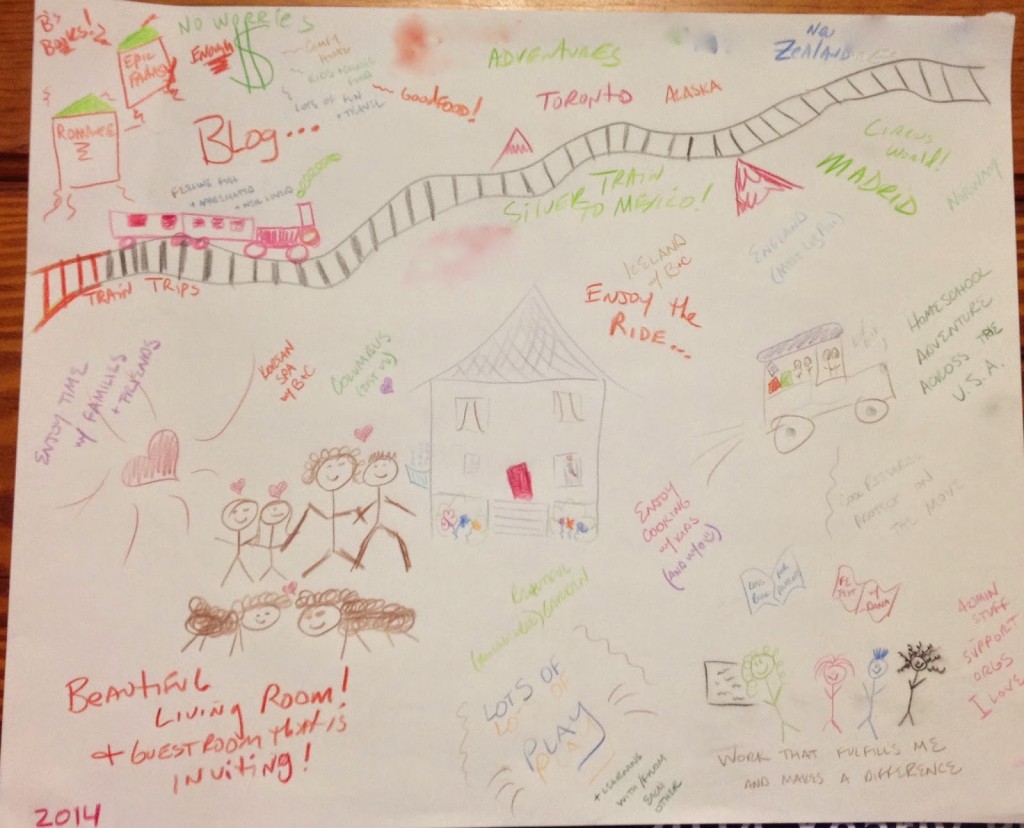
As part of my planning process every three years, my partner and I sit down with a bottle of wine and markers and draw a joint three year plan on poster sized paper. We dream, get silly, drink, and have fun. I post the picture behind the door in my office, right over my big calendar that I talked about in this post about how to keep track of multiple projects

It is not pretty to look at, but when we look back at the old one when it is time to do a new one, it is pretty amazing how much we have accomplished. Why? Because we verbalized what we wanted to do for ourselves and for our family, which means we work together to support each other in our adventures.
It also reminds us what our priorities are, which means we funnel our time, energy, and financial resources into our plans and dreams. Making plans is the difference between accomplishing anything and accomplishing nothing.

People get hung up making plans because they try and force themselves to conform and write a numbered straight list, editing themselves as they go, afraid of writing down what they really want to accomplish.

This year, loosen up, get out your big paper, markers, beverages of your choice, and have fun.
Dream big.

 Have a safe and happy New Year.

All I Want for Christmas

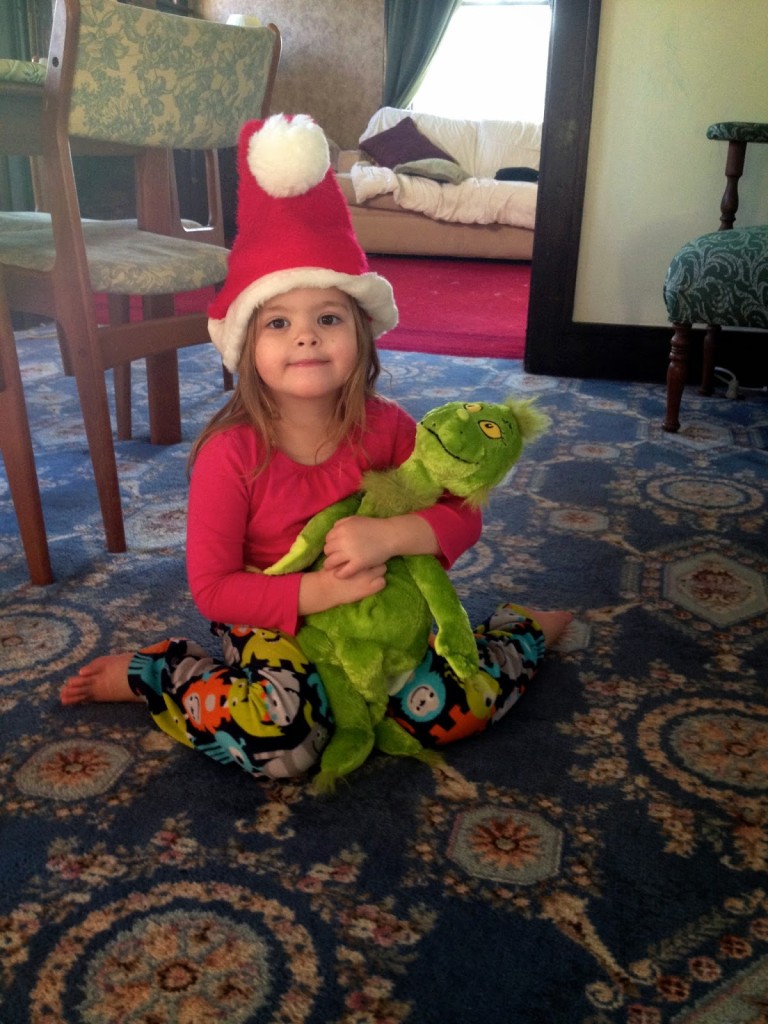
 Every year I find myself more frustrated with the rampant consumerism and ridiculous advertising messages implying that what you spend equals how much you love someone.  I have always hated that part of Christmas, and the pressure I see people put on themselves to buy the perfect gift, whatever that might be. As the Grinch said, and I am paraphrasing here: Christmas doesn’t come from a store.
As a nurse, I have spent many holidays at the hospital watching families get the best gift of all, a new person to love in their life. I have held hands as families have let go of loved ones too. Remembering friends and family no longer with us physically, I am reminded that each year is a gift.
This year, all I want is more moments like this,


and this.


Take time to enjoy your family and friends this holiday season whatever you celebrate!

Keeping Track: Tips for Managing Multiple Writing Projects

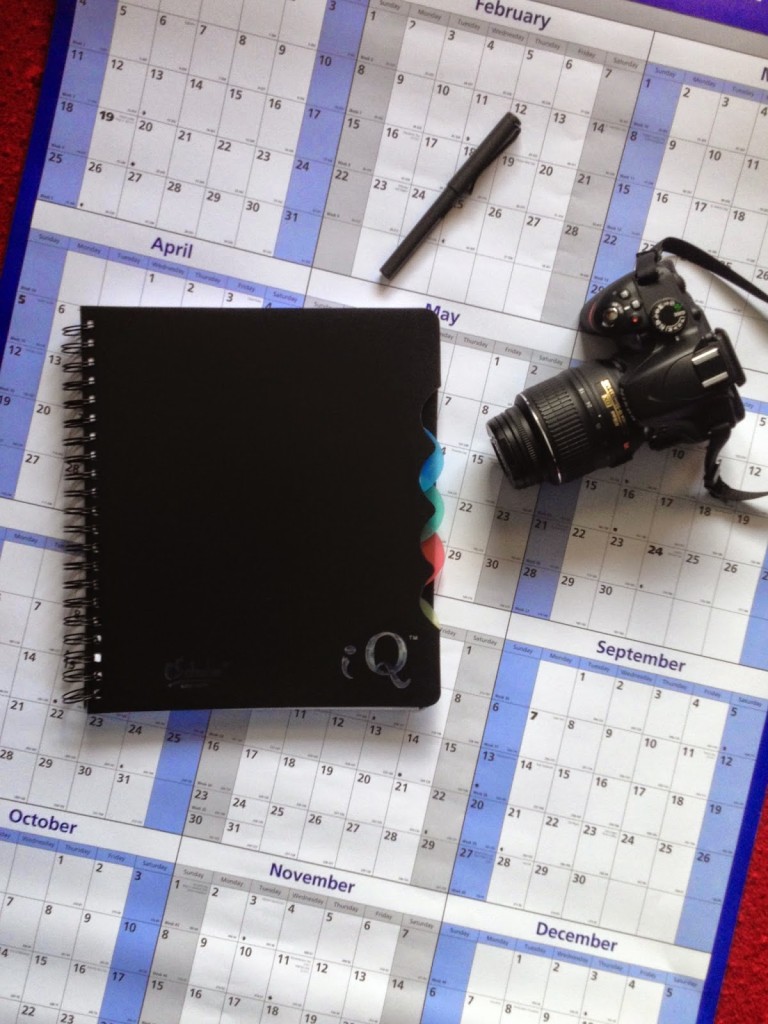
It is not uncommon for me to have at four or five writing projects in progress. The gift of ADHD means that I always have projects. Some are large, long term projects such as developing my editorial calendar, manuscript drafts and edits, others are short such as website content and blog posts, and some fall in between, think short stories and journal articles. Although I love the reminder feature on my Google calendar, as a visual person I have difficulty conceptualizing time when it is represented by little boxes on a computer screen limited to a one month view.


Click here for my post on Creative Acts and Self Care

I need to see it all. My solution is a twelve month wall calendar. I like a Write on/ Wipe off type, ever so helpful if deadlines, or project details change.
I know some people are able to just work on one thing, and then move on to their next project, but my mind does not work that way. I need to be able to move to a different project when I get bored with what I am working on, and want to start something new (because new always feels good), going back to another project gives me the same feeling of doing something different, and yet it propels me forward in that task so in the end it all gets done.

Click here for my post on using flat files to keep my big projects organized

I also make notes in each file, listing the next steps to complete the project. For example, word count goals, scenes left to write or rewrite, necessary research, lists of of photographs/ images needed, correspond with a co-author, conduct an interview, follow up on an email, etc. I make these notes at the end of the manuscript and/or on the outline.  What, no outline? Read my post about outlines here. Outlines really are helpful.
I started keeping my Next Steps List when I was working on my master’s thesis. It kept me on track so I could finish my thesis on time, using every second of time I had to work effectively.
A Next Steps List helps in three ways:
1. You know what you need to do next to move toward completing your project and can get right back to work after a break in writing, invaluable with limited writing time.
2. A Next Steps List clears your brain so you can move on and work on other projects without the distraction and worry that you are forgetting something.
3. Crossing out tasks as you finish them is a visual reminder that you are making progress. A visual reminder of your progress helps maintain motivation on long projects.

In addition to my other writing projects, I write this blog and am starting another in February. (Stay tuned for details).  If you are a blogger, or want to be one, the best thing you can do for yourself is to create an editorial calendar. An editorial calendar is simply a calendar that you use to plan posts that you want to write, give them publishing dates and plan your posts. Keep it loose, give yourself permission to change what your post is about if you don’t want to write about that topic that week. Your editorial calendar allows you to plan in advance, gives you a place to park all your ideas for posts, and keeps you focused on your goals for the blog.

Most writers deal with deadlines, family obligations, work, holidays, and travel. Having a long term plan will help you stick to your writing schedule, turn projects in on time, and increase your productivity.  Make a plan. Hatch your dreams. Keep writing.

Megan Hart’s Lovely Wild_ A Year of Women’s Voices


I met Megan Hart at the CNRWA Spring Fling 2014 conference. She was charming and hella funny. One of the things we talked about besides RVs and family vacations, was music and writing. I appreciate Megan’s ability to write across many different genres. It is not often you find a writer that has a story for you, no matter what your mood.In Lovely Wild, Megan Hart’s most recent release, Megan brilliantly tells the story of Mari, a woman with a past that does and does not define her. Over a summer spent in her childhood home, Mari discovers past and present betrayals, encounters her hidden history, and finds her strength in the love she has for her children and herself. Reminding us all that people can be so much more than they appear to be, Mari is a character that you will remember long after you close the book. Lovely Wild is a story of growth, redemption, and family secrets that will keep you turning pages with that wonderful edge of your seat feeling that comes with a well written suspense novel. Be advised, do not start this book at bedtime unless you want to stay up all night reading.

Megan includes playlists in each of her books that enrich the reading experience in a visceral way. If you have read Megan’s other books, and let us be clear here, you should, listen to the playlists included, it is a way to enjoy the story all over again.  I had some questions about how Megan uses music when she writes and Megan has answered them here:
 1.    Have
you always written / worked to music?
Megan Hart: Yes!
Honestly, the iPod was the best invention ever, because before that I had to
make mix tapes and/or CDs and use them for playlists. So yes, I have always
used music while writing.
2.
Do
you sing along with the lyrics when you are writing? 
Megan Hart: Absolutely.
And sometimes I dance.
  
3.
Do
you have playlists for certain types of writing?
Megan Hart: Not
necessarily for different types of writing, but definitely a different playlist
for each book. The songs can be pertinent or somehow relating to the book or
just what I happen to be into listening to at the time, but what’s so crazy is
that when I look back at what songs are on old playlists, I can really sink
back into how it felt when I was writing that book.
4.
How
does music influence you? Is it a way to block distractions, or do you think
that the mood created by lyrics / music enables you to get where you need to be
emotionally for what you are writing?
Megan Hart: Both.
If I’m trying to write in a public space (which I had to do a LOT when my kids
were smaller and I’d write in a coffee shop or the playground or whatever) the
music definitely is used to block out the distractions. But also, when I put on
something sad or happy or ethereal it really gets me into the spirit of the
book. I have a long playlist of songs that stab me in the heart, and I listen
to them to get where I need to be for the writing, because fortunately my
default emotional setting is not woebegone angstmonster. So I have to find a way
to dig into that, and music helps.
 
5.
Have
you ever written lyrics, or considered writing songs?
Megan Hart: I have. I write lyrics a lot, but I can’t
read or write music, so it’s really not very productive! I wrote a song for a
story that will be out some time in 2015 and someone did write music for it,
which was amazing.
 
6.
Do
you listen to different types of music when you are editing versus first draft?
Megan Hart: Not
really. Pretty much the same throughout.
 
7.
Do
you listen to the same playlist each time you work on a project?
Megan Hart: Yes,
usually.
 8.
Does
the music suggest the story, or does the story come you and then the music?
Megan Hart: Story
comes first, then I find the music that fits. There have been a few times when
a song inspired something, or lyrics have prompted a scene, but usually the
music is backdrop.
9.
What
of music do you detest?
 Megan Hart: Jazz.
I hate jazz so much. Jazz makes me want to stab out my ears. Modern jazz, I
guess, all the boopdeleeboopedeedoo whatever. Once I went to a modern jazz band
with my husband and I wanted to both die and kill everyone in the room at the
same time, that’s how much I hate it.
10.  What kind of music is
your favorite?
Megan Hart: That’s
a harder question to answer. I love such a wide range. I love classical, pop,
hip hop, rock, hard rock, heavy metal…really, I love almost everything (except
modern jazz.)
As a writer this is what I have learned reading Megan Hart:

1. Great stories do not have to be set in exotic
locations.
2.  Internal dialogue is as important as external
dialogue.
3.  Pacing is essential to building suspense.
4.  Create characters that are capable of doing the
extraordinary when they reach the tipping point.
5.  Embrace the dark side of your characters, all of
them, not just the villains.
6.  Emotions are never
simple, don’t be afraid to show exactly how complicated they are.
7.  Do not back off from
social class conflict and social expectations, show just how deep and ugly they
can be.
 Mega Hart’s new novel Lovely
Wild is out now: You can purchase the book here or your favorite independent book store